Holo / Or Ltd. (Israel): Holoror: Holoor (Israel):Diffractive Optical Element (DOE) Manufacturer
Please contact the import agency Taihei Boeki for details.
2D Beam Splitter DOE Holo / Or (Holoor)
A diffractive beam splitter (also known as a multi-beam or dot generator) is a diffractive optic used to split a laser beam into multiple beams with the characteristics of the original beam (excluding power and propagation angle). (DOE) (DOE: Diffractive Optical Element).
Depending on the diffraction pattern on the device, a one-dimensional beam array (1xN) or a two-dimensional beam matrix (MxN) can be generated. It is also used in monochromatic light such as laser beams to specify the wavelength and separation angle of the output beam.
Two-dimensional beam splitteris used in applications such as laser scribing (solar cells, panels, etc.), laser dicing, laser perforations, aesthetic medicine, 3D sensing & projection, etc.
Holo/Or has a variety of standard products. Also, if you cannot find the specifications you want, we also support custom design from one piece.
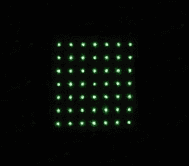
Applications
- Laser processing
- Laser scribing
- Glass dicing
- Laser display & illumination
- Machine vision & 3D sensor
- Optical fiber
- Medical / beauty treatment
principle
The split order is the same copy of the incident beam, with the same parameters such as size, divergence, intensity distribution, polarization, and beam quality. The equation for the grating for a normal incident light source is:

Λ: DOE cycle
m: Diffraction order
λ: Wavelength
α: Angle between the diffraction beam of degree m and the optical axis
m: Diffraction order
λ: Wavelength
α: Angle between the diffraction beam of degree m and the optical axis
Diffractive splitters, like other DOEs, are manufactured for specific wavelengths. At other wavelengths, efficiency is reduced and the diffraction angle changes. There is no problem if the error is about 1 to 2% from the design wavelength. In addition, because of the high degree of freedom in design, the one-dimensional beam array (1xN) order and the power ratio for each order can be freely set.
Basic optics setup
There are two types of optical systems for diffractive beam splitters, a-focal and focal. In the case of a-focal, there is no focal plane after the beam splitter, and the image size changes linearly with the distance from the DOE. For focal, optimal performance is obtained with the focal plane of the condenser lens placed after the DOE.
When combined with a condenser lens (each spot is the same as the diffraction limit of the lens)
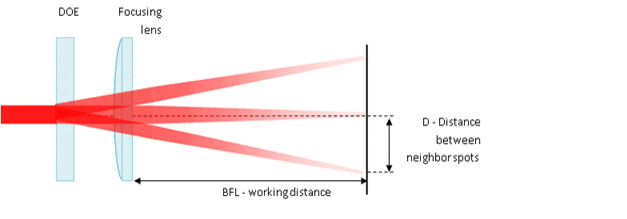
Separation distance between spots of diffractive beam splitter
| DOE before focusing optics | DOE after focusing optics |
| D = EFL・ Tana | D = WD・ Tana |
EFL: Effective focal length
WD: Working distance
WD: Working distance
About 0th order light of beam splitter
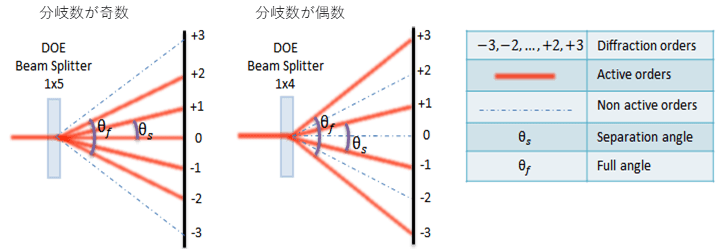
0th order light (ZO) is related to manufacturing tolerances that cause a small portion of the incident light to be unaffected by the diffraction pattern. The effect of these tolerances is an increase in energy on the axis, the central spot.
In an odd-numbered diffraction design, the 0th-order light is one of the specified output beams, unlike the even-numbered design. Therefore, we recommend using an odd number of spots design instead of an even number of spots.
In an odd-numbered diffraction design, the 0th-order light is one of the specified output beams, unlike the even-numbered design. Therefore, we recommend using an odd number of spots design instead of an even number of spots.

Performance comparison due to design differences (binary, multi-level)
There are two main types of diffraction beam splitters from Holo/Or (binary and multi-level).The binary diffraction pattern consists of only two levels (stages) and is called the "workhorse" of diffractive optics. It has excellent cost performance and manufacturing reproducibility, and is suitable for most applications.
The downside of binaries is that they are about 80% efficient. If higher efficiency is required, such as for high-power industrial lasers, select from multi-level elements. Multi-level devices can achieve efficiencies of 95% or higher, although the manufacturing process is more complex and costly.
The downside of binaries is that they are about 80% efficient. If higher efficiency is required, such as for high-power industrial lasers, select from multi-level elements. Multi-level devices can achieve efficiencies of 95% or higher, although the manufacturing process is more complex and costly.
| binary | Multi-level | |
| Design freedom | Symmetric dot pattern only | any |
| efficiency | Limited <~ 80% | ~ 96% |
| Uniformity | ◎ | 〇 |
| Full angle | ~ 40deg at 1064nm | ~ 10deg at 1064nm |
| Cost | ◎ | 〇 |
Specification.
| Glass material | Synthetic quartz, sapphire, ZnSe, germanium, plastic |
| wavelength | 193nm ~ 10.6μm |
| DOE design | Binary (2 levels) to 16 levels |
| Full angle | 0.001deg ~ 80deg |
| efficiency | 64% -98% |
| Element size | Several mm to 150 mm |
| coating | AR / AR |