Holo / Or Ltd. (Israel): Holoror: Holoor (Israel):Diffractive Optical Element (DOE) Manufacturer
Please contact the import agency Taihei Boeki for details.
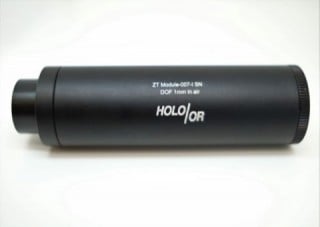
DEEP CLEAVE DOE Holo / Or (Holoor)
A diffractive optical module designed to focus a single-mode Gaussian beam on a tight spot with a waist size of approximately 0.25 um with a constant peak power along a long depth of focus (DOF) of 3 to 1.8 mm.
Focusing spots correspond to an objective lens NA of 0.35, so Deep Cleave is a complete optical solution that does not require the addition of high NA objectives or other expensive optics.
Holo/Or deep cleaves are typically used for cutting laser glass in the near infrared wavelength range and are ideal for cutting thick glass such as flat panels. It is also used as a microscope in green visible light range lasers.
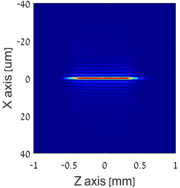
Laser filament formation
High-energy lasers can cause self-focusing, called "filamentation," inside the glass. Holo/Or's Deep Cleeve and Diffractive Axicon are also used as a method of forming "filaments" inside glass, and Deep Cleeve is recommended especially for glass cutting solutions for ultrashort pulse lasers (UPS).
Reasons for cutting glass
Deep cleave focuses an incident single-mode laser on a tight spot with a waist size of approximately 1um over the entire depth of focus (DOF) range (typically 2-1.8 mm).The focusing spot has an objective lens NA equivalent to 0.35 and is ideal for cutting thick glass such as flat panels. Modules are a complete optical solution for cutting transparent materials. No need to add high NA objectives or other expensive optics.

- The entire surface of the glass can be cut with a single pulse
- A complete solution in one module
- Very low aberration level with spot diameter of 2 μm or less
- Easy to incorporate into existing optical equipment
Real-time measurement of deep cleave intensity profile
Setup: ZT Module-007-I, camera + objective lens
Benefits of deep cleave
The advantage of deep cleave is an alternative solution for laser glass cutting applications. There are solutions such as the Axicon that produce a long focal length Bessel beam, but their sharp transmission area makes them superior in that they have a flat top shape that consumes little energy.
This is different from the definition of a Bessel beam, which either "overshoots" with energy above the threshold or wastes energy with the "tail" of energy below the threshold.
Unlike Axicon, it can increase throughput by generating an optimal energy distribution within the effective pulse region and reduce the processing power to cut the same substrate thickness. Depending on the conditions, it is also possible to cut glass that is about 2x thicker than a standard Bessel beam to which the same processing power applies.
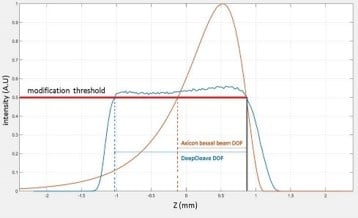
Intensity distribution along the focal axis (z axis) when the same amount of energy is applied to deep cleave and axicon.
Specification.
| wavelength | 1030nm, 1064nm, other wavelengths (semi-custom) |
| Beam mode | Single Mode M² <1.3 |
| DOF (air) | 0.25mm - 3mm |
| Waist diameter [exp ^ -2] | 1.8um |
| efficiency | Up to 93% |
| WD | 7.4mm --15 mm |
| Size | 30.5 mm diameter x 106 --250 mm length |
| Glass material | Synthetic quartz |
| Coats | AR / AR |
Product List
| Model | wavelength (Nm) | Laser specifications | Incident diameter (1 / e², mm) | DOF (air) (mm) | Waist diameter (1 / e², μm) | WD (mm) | Data seat |
| ZT Module-004-J | 1030 | Single mode M2 <1.3 | 6 (± 10%) | 0.5 | 1.8 | 7.4 | |
| ZT Module-005-J | 1030 | Single mode M2 <1.3 | 6 (± 10%) | 0.75 | 1.8 | 7.4 | |
| ZT Module-006-J | 1030 | Single mode M2 <1.3 | 6 (± 10%) | 1.5 | 1.8 | 7.4 | |
| ZT Module-007-J | 1030 | Single mode M2 <1.3 | 6 (± 10%) | 1 | 1.8 | 7.4 | |
| ZT Module-008-J | 1030 | Single mode M2 <1.3 | 6 (± 10%) | 0.25 | 1.8 | 7.4 | |
| ZT Module-009-J | 1030 | Single mode M2 <1.3 | 6 (± 10%) | 3 | 1.8 | 7.4 | |
| ZT Module-004-I | 1064 | Single mode M2 <1.3 | 6 (± 10%) | 0.5 | 1.8 | 7.4 | |
| ZT Module-005-I | 1064 | Single mode M2 <1.3 | 6 (± 10%) | 0.75 | 1.8 | 7.4 | |
| ZT Module-006-I | 1064 | Single mode M2 <1.3 | 6 (± 10%) | 1.5 | 1.8 | 7.4 | |
| ZT Module-007-I | 1064 | Single mode M2 <1.3 | 6 (± 10%) | 1 | 1.8 | 7.4 | |
| ZT Module-008-I | 1064 | Single mode M2 <1.3 | 6 (± 10%) | 0.25 | 1.8 | 7.4 | |
| ZT Module-009-I | 1064 | Single mode M2 <1.3 | 6 (± 10%) | 3 | 1.8 | 7.4 | |
| ZT Module-010-I | 1064 | Single mode M2 <1.3 | 10 (± 10%) | 1 | 1.8 | 15.5 | |
| ZT Module-011-I | 1064 | Single mode M2 <1.3 | 12 (± 10%) | 1 | 1.8 | 23.7 | |
| ZT Module-009-R | 488 | Single mode M2 <1.3 | 6 (± 10%) | 3 | 0.85 | 7.4 | |